1. Core essence
The Yi Torch Festival is a traditional festival shared by ethnic minorities such as the Yi, Bai, and Naxi in Southwest China, with the celebration of the Yi people in Liangshan, Sichuan being the most grand. Its core is the use of fire as a medium, integrating multiple functions such as worship, agriculture, socialization, and entertainment. It has been listed as a national intangible cultural heritage (2006) and was included in the UNESCO List of Intangible Cultural Heritage in Urgent Need of Protection in 2010, highlighting its cultural uniqueness and endangered status.
2、 Cultural Connotation Trio
nature worship
Fire God Worship: The Yi people regard fire as a symbol of purification and rebirth, lighting torches to expel insects and ward off evil, and praying for a bountiful harvest.
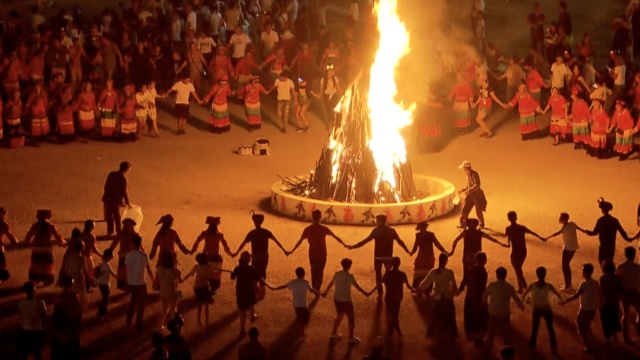
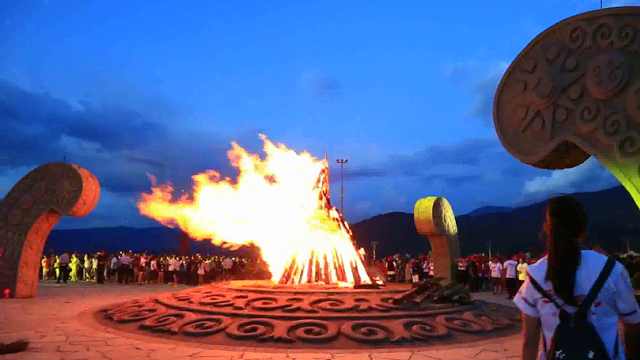
Starfire echoes: At night, torches connect to form a galaxy, symbolizing the resonance between human fire and celestial phenomena, reflecting the concept of animism in all things.
Historical memory
Heroic legends: spread stories such as “using fire to outsmart the gods” or “burning locusts with torches to save food” to strengthen ethnic identity.
Migration password: The torch team simulates the migration route of ancestors, hiding the path symbols of the Yi ethnic epic “Le Ot Yi”.
social bonds
Gender equality: Women can hold torches and march, breaking daily taboos; Choosing a spouse through singing and promoting interethnic marriage.
Dispute mediation: Using festivals as an opportunity to resolve conflicts, reflecting the folk wisdom of “ending disputes with celebration”.
3、 Full record of live ceremony
1. Three day process
Day 1: Sacrifice to Fire
Bimo (priest) recites sutras, takes the ancient “drilling wood fire” to light the sacred altar, and the villagers relay the fire to every household.
The next day: Fire Racing
Bullfighting and horse racing: The winner receives a “hero ribbon”, symbolizing courage and the prosperity of the clan.
Duoluo lotus dance: a female yellow umbrella spinning dance, singing and reciting the epic creation of the Yi ethnic group, with movements like swaying rice ears.
Apocalypse: Sending Fire
The torch gathers into a dragon and swims towards the mountains, burning the scarecrow symbolizing disaster, and scattering ashes on the fields to make fertilizer.
2. Distinctive symbols
Yellow Umbrella: Sunshade Artifact → Sacred Artifact (Umbrella handle engraved with the twelve zodiac animals, symbolizing reincarnation).
Tuo Tuo Rou: Large chunks of boiled lamb meat, torn and eaten by hand, reflecting the tribal tradition of “sharing meat together”.
4、 Challenges of Modern Transformation
Commercialization erosion: Scenic area performances replace spontaneous ceremonies, and torch parades become paid items (such as Chuxiong, Yunnan).
Inheritors are cut off from generation to generation: The younger generation is more enthusiastic about electronic music parties, and the number of readers of Bimo scripture recitation is less than a hundred.
Ecological conflict: Traditional pine torches are replaced by LED lights, losing their practical function of burning and killing insects.
5、 Suggestions for participation
Time: On the 24th day of the sixth lunar month (between July and August in the Gregorian calendar), official events in Liangshan Prefecture will last for 3-5 days.
Location: Zhaojue County, Sichuan Province (primitive), Shilin County, Yunnan Province (cultural and tourism integration), Weining County, Guizhou Province (multi-ethnic celebration).
Taboo: Do not step on the ashes of torches; Women are not allowed to come into contact with the sacred flame during their menstrual period (it still exists in some areas).
Conclusion: Torch Festival is the “cultural chip” of the Yi people. In the flickering flames, we can see how a nation illuminates its past and future with flames.