
 In the long river of Chinese civilization, there exists an art form as brilliant as the stars—movable type printing. Crafted from clay, wood, or metal, it became a vessel for wisdom, scattering the seeds of knowledge across the world. More than a technological revolution, it stands as one of China’s most elegant gifts to humanity.
I. The Birth of a Millennium’s Brilliance
During the Qingli era (1041–1048) of the Northern Song Dynasty, an ordinary artisan named Bi Sheng glimpsed divine inspiration amid the laborious woodblock printing process. He carved individual characters from clay, fired them into hardened type, and arranged them freely like scattered clouds. This breakthrough—four centuries before Gutenberg’s metal type in Europe—marked an “Eastern Renaissance” in human history.
“One character holds a universe; a thousand characters weave a world.” The flexibility of movable type liberated books from their exorbitant cost, allowing knowledge to flow like spring rain, nourishing even the humblest alleys.
II. The Artisan’s Legacy: The Graceful Craft of Movable Type
The soul of movable type lies in the meticulous selection of materials:
Clay type: Bi Sheng’s original invention, simple as pottery yet fragile;
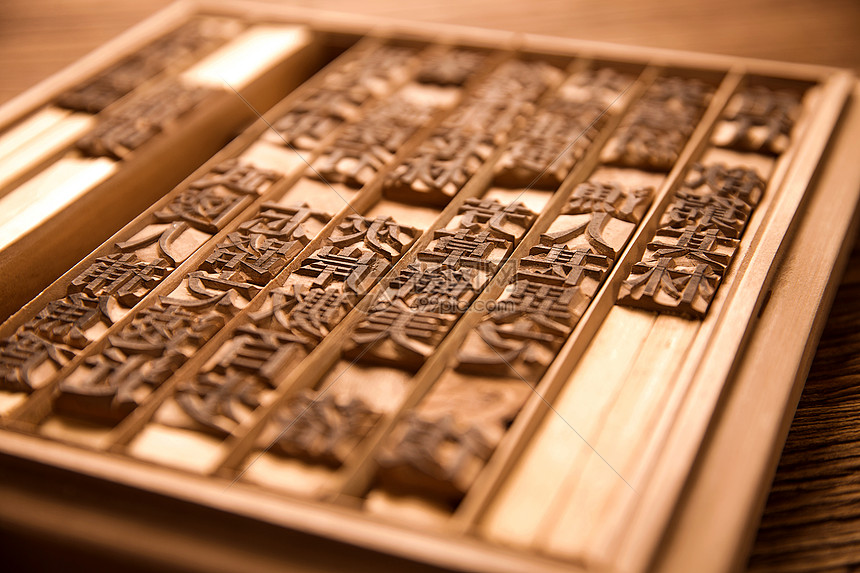
Wooden type: Refined by Wang Zhen of the Yuan Dynasty, carved from pear or jujube wood, its grain infused with the scent of ink;
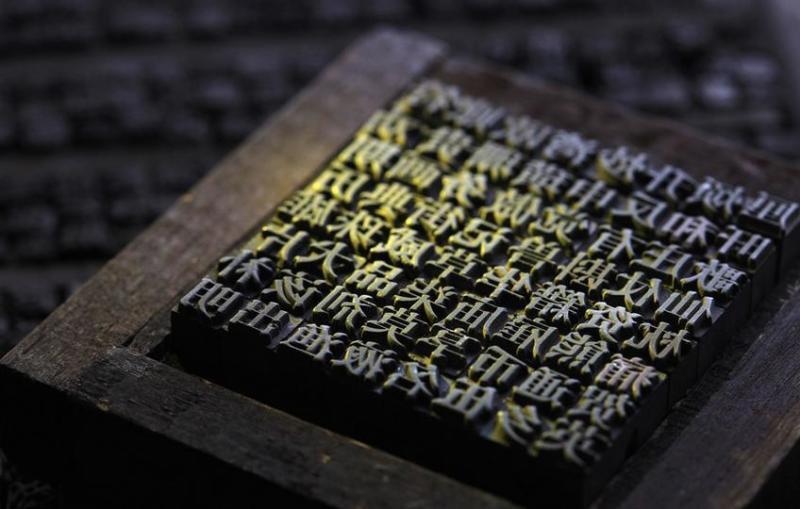
Bronze type: Favored in the Ming and Qing Dynasties, its metallic sheen graced imperial texts like Yongle Encyclopedia and Complete Collection of Ancient and Modern Books;
Tin type: A Qing-era innovation from Guangdong, durable and perfect for delicate scripts.
Each piece of type underwent five stages—material selection, carving, firing, typesetting, and printing. With knives as brushes, artisans etched the bones of Chinese characters onto tiny blocks; with ink as their spirit, they imprinted civilization onto blank pages.
III. Ripples of Civilization: Movable Type’s Global Echo
 Travelling the Silk Road, movable type stirred a worldwide intellectual revolution:
Korea pioneered metal type, producing Jikji (the world’s oldest extant metal-printed book);
Europe’s Gutenberg drew inspiration, igniting the Reformation and the Enlightenment;
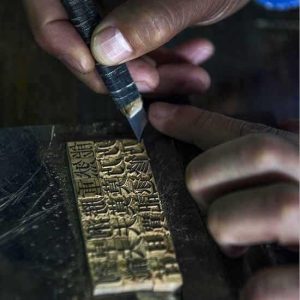
Today, in Rui’an, Zhejiang, villages preserve wooden movable type printing, where artisans’ hands still dance to a thousand-year-old rhythm.
IV. Rebirth in Modernity: The Awakening of Movable Type Art
No longer a tool of industry, movable type has been reincarnated in new forms:
In heritage workshops, visitors set type by hand, touching the texture of history;
In art and design, type becomes bookmarks and seals, adorning the desks of scholars;
In the digital age, movable type fonts are encoded into pixels, extending classical beauty into virtual realms.
“It emerged from the depths of time, carrying the scent of ink and the chime of metal, whispering: Civilization never fades—it simply learns to breathe anew.”